
Atlantic Beach · Duval County
Foundation Inspections in Atlantic Beach, FL
A focused evaluation of slab, stem wall, block or pier foundations — crack patterns, movement, floor level, drainage and the site conditions actually causing the problem. We inspect your Atlantic Beach home and email a detailed photo report.
Mon–Sat 8am–6pm · InterNACHI certified, Florida licensed and insured · 20+ years construction and renovation experience
A foundation inspection in Atlantic Beach covers slab cracking and differential movement, wall cracks and their pattern, door and window operation, and drainage and grading around the structure. It takes an hour to two hours and produces a report distinguishing cosmetic cracking from movement that warrants an engineer. Typical cost runs $200–$450 per inspection. In Atlantic Beach this inspection tends to be ordered to settle a question — what is actually wrong, and what will it cost.
- Typical cost
- $200–$450per inspection
- Building stock
- Coastal barrier
- Permitting
- Duval County
Foundation Inspections in Atlantic Beach
Atlantic Beach has the oldest and most interesting housing of the three Duval beach towns — small 1930s and 1940s cottages in the Old Atlantic Beach grid under a mature oak canopy, mid-century ranches in Selva Marina, and a growing number of large rebuilds. The canopy is beautiful and it is also an inspection issue: shaded roofs hold moisture, and mature oaks put branches and root systems where they cause problems. In Atlantic Beach, foundation inspection findings follow the building stock: salt air, wind-borne debris exposure and the moisture detailing that coastal walls live or die on. We are InterNACHI certified, Florida licensed and insured, and we inspect every Atlantic Beach home to the same standard.
Old Atlantic Beach cottages routinely still have original or partially updated systems behind a nice remodel — cloth-insulated branch circuits, galvanized supply, and cast-iron drains. We open panels and look at terminations rather than trusting the age of the cover. Shaded roofs under oak canopy grow algae and hold moisture, which shortens shingle life and rots decking at valleys and low-slope tie-ins, so we check decking condition from the attic side. Marsh-front homes on the Intracoastal side get the same salt corrosion review as oceanfront — the aerosol reaches them — plus a look at any dock, bulkhead, or elevated deck framing. On a foundation inspections specifically, that means concentrating on slab cracking and differential movement, wall cracks and their pattern, door and window operation, and drainage and grading around the structure.
What we run into repeatedly in Atlantic Beach
Storm surge and dune erosion define the ocean side, and the marsh side floods from the Intracoastal and the tidal creeks feeding Dutton and Tideviews. Atlantic Beach permits separately from the City of Jacksonville and enforces a tree protection ordinance that affects what a buyer can do with a lot after closing — worth understanding before you plan an addition or a pool. Insurance is the practical squeeze: roof age past twenty on the island triggers non-renewal pressure, and mid-century houses that have never been re-nailed at the roof deck score poorly on the wind mitigation form. Across Old Atlantic Beach, Selva Marina and Ocean Walk, these are the patterns that repeat.
Neighborhoods and landmarks
We inspect throughout Atlantic Beach, including the areas around Beaches Town Center, Dutton Island Preserve, Tideviews Preserve, Naval Station Mayport, Intracoastal Waterway. Median stock here runs 1930s–1960s in Old Atlantic Beach, 1960s–1980s in Selva Marina and Royal Palms, with steady modern infill and rebuild.
- Old Atlantic Beach
- Selva Marina
- Ocean Walk
- Royal Palms
- Atlantic Beach Country Club
- Seminole Beach
Coastal and barrier-island building stock in Atlantic Beach
On a barrier island, the ocean is a testing lab running twenty-four hours a day. Salt aerosol carries several blocks inland and it attacks anything metal — condenser coils, fasteners, panel bus bars, hurricane connectors, railing anchors. A heat pump that lasts fifteen years three miles inland routinely gives out at eight to ten on the beach. On top of that, most of this area sits inside the Florida Building Code wind-borne debris region, so opening protection is not optional on new work and its presence or absence is one of the largest single line items on a wind mitigation report. The two questions we answer on every island inspection are: what is the true remaining life on the metal systems, and can this envelope actually be documented for insurance? Both change the number a buyer should be willing to pay.
What this building stock produces on a foundation inspections
- Corroded HVAC condenser coils, fan cages, and disconnect boxes — often at half of expected service life
- Rusted roof and wall fasteners, hurricane straps, and lintels showing rust-jacking through stucco
- Stucco-over-block cracking at corners and openings, with moisture intrusion behind the coating
- Missing, undocumented, or non-code-compliant opening protection in the wind-borne debris region
- Roof edge and drip edge detailing that will not hold in uplift, and lifted or creased shingle tabs
- Elevated foundations with corroded connectors, deteriorated pile jackets, or enclosed below-BFE space
- Salt-corroded electrical panels, breakers, and exterior receptacles on the ocean side of the house
- Deck, balcony, and railing attachments with rusted or undersized anchors
When to book foundation inspections
If one of these applies to the Atlantic Beach property you are looking at, this is the inspection to order.
- Cracks in interior drywall running diagonally from door and window corners
- Doors and windows that stick, bind, or have visibly out-of-square gaps at the top
- Floors that slope, or a marble that rolls consistently in one direction
- Stair-step cracking in concrete block or brick veneer at the exterior
- A horizontal crack in a stem wall, or visible separation at the slab edge
- Tile grout cracking along a consistent line across multiple rooms
- Gaps opening between the floor and baseboard, or between a wall and ceiling
- A foundation repair company gave you a free estimate and you want an independent read before you sign
Need foundation inspections in Atlantic Beach?
Call 904-806-7679 and you get William Knight directly — the same person who will be on your roof and in your attic, and who writes the report afterward.
Mon–Sat 8am–6pm · 20+ years construction and renovation experience · InterNACHI certified, licensed and insured
What foundation inspections covers
Florida foundations fail differently from foundations in expansive-clay markets, and importing the wrong mental model causes both unnecessary panic and missed problems. In parts of Texas and Oklahoma, the dominant mechanism is soil that swells and shrinks dramatically with moisture, heaving and dropping the slab seasonally. Northeast Florida sits mostly on sandy soils over limestone. Sand does not swell. What it does is move: it washes out, it consolidates under load, and it settles where fill was poorly compacted. So the failure modes here are washout and differential settlement, plumbing leaks eroding material out from under the slab, organic or debris-laden fill left in place during site work, poorly compacted fill on a graded lot, tree root activity, and in limestone areas the possibility of subsurface voids.
The single most common cause of real slab movement we encounter is water that should not be there. A pressurized supply line leaking under a slab can move a remarkable volume of sand over months, and the first symptom is often not a wet floor. It is an unexplained jump in the water bill, a warm spot on a tile floor if the leak is on the hot side, the sound of running water with all fixtures off, or a hairline crack that widens over a season. Sanitary drain leaks do the same thing more slowly. Outside the slab, the usual suspects are downspouts discharging at the foundation, negative grading, irrigation heads soaking one corner of the house daily, and a failed area drain. Fix the water and the movement usually stops.
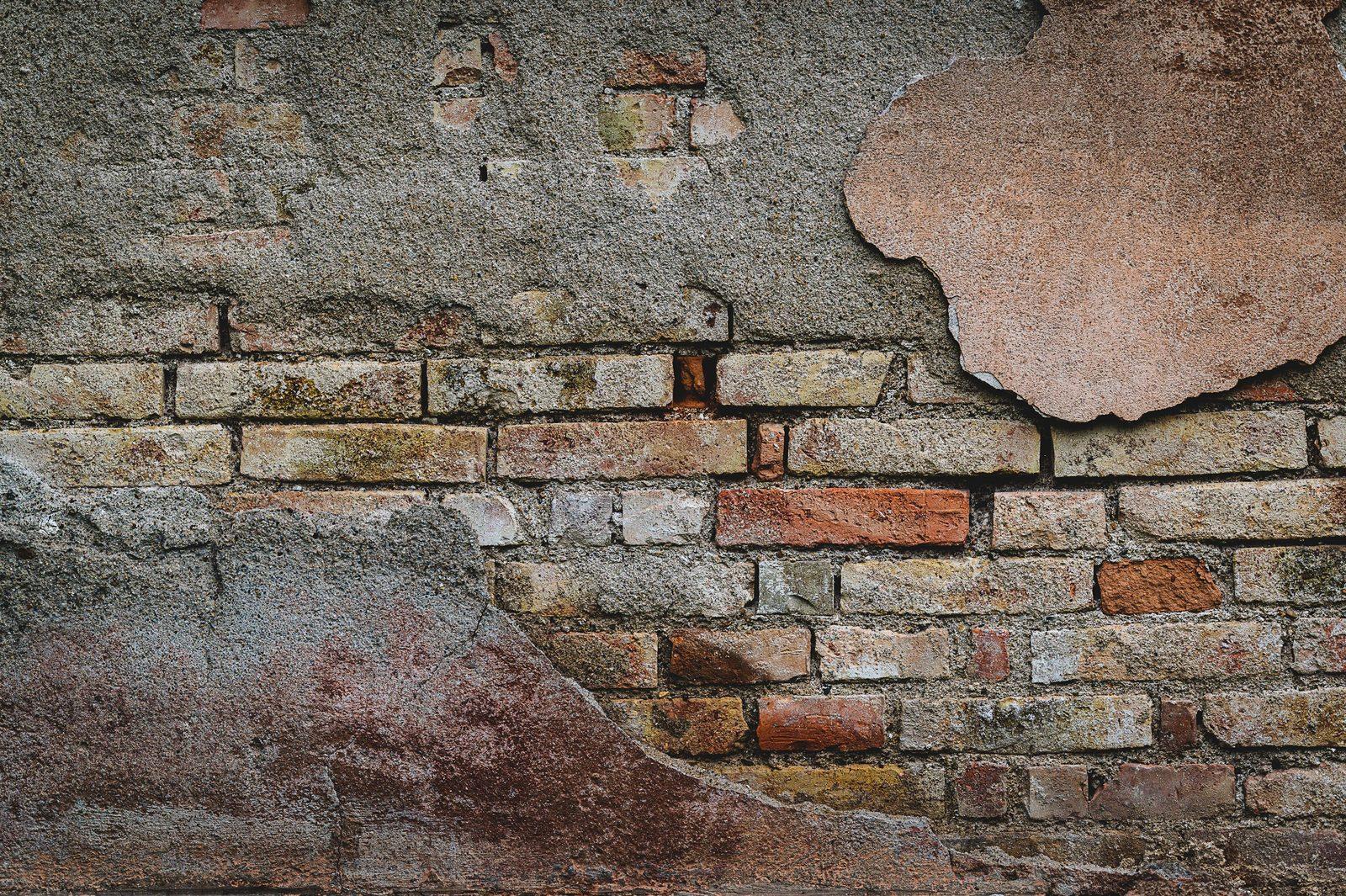
Most cracking is not structural, and saying so plainly is part of the job. Concrete shrinks as it cures and cracks as it shrinks; that is expected behavior, not a defect. Hairline cracks in a slab, in a garage floor, in a driveway, at control joints, and in stucco at window corners are so common as to be unremarkable. Vertical hairline cracking in a block wall at a mortar joint is usually shrinkage or minor thermal movement. What deserves attention is different in character: diagonal or stair-step cracking through block and mortar, cracks wider than roughly a quarter inch, cracks with vertical or lateral displacement where one side sits proud of the other, cracks that grow measurably over time, and horizontal cracking in a foundation wall.
The evaluation is about pattern, not any single crack. We look at whether cracking is concentrated in one quadrant of the house, whether interior doors and windows bind or show tapered gaps at the head, whether floors are out of level and in which direction, whether tile grout lines have opened along a consistent line, whether exterior cracking lines up with interior cracking on the same plane, and whether the roofline and soffit run true. Elevation readings across the floor establish whether there is a real slope and how much. A house that has settled uniformly is generally fine. A house where one corner has dropped three quarters of an inch relative to the rest, with cracking radiating from that corner, is telling a story.
Slab-on-grade is the dominant foundation type in the region's post-1970 housing, with stem-wall and monolithic variants common and crawl space or pier-and-beam prevalent in older rural stock and along the river. Coastal and flood-zone construction adds elevated foundations on piles or piers, where the concerns shift to salt-air corrosion of connectors and reinforcement, scour around footings, and the condition of any breakaway wall assembly. Concrete block with stucco, which dominates in Palm Coast and much of the Volusia and Flagler stock, has its own vocabulary: efflorescence, spalling where reinforcement is corroding, and cracking at unreinforced openings. The report identifies the type first, because the diagnostic questions differ completely.
Where a home inspection ends and an engineer begins is a real line and we will tell you when you are on it. A home inspection reports observed conditions, patterns, and elevation differences, and it recommends. It does not perform structural analysis, calculate loads, design a repair, or issue a stamped opinion. When findings indicate active differential movement, a Florida-licensed professional engineer is the correct next step, and their report is what a lender, an insurer, or a repair contractor will want. Order plumbing testing at the same time when a leak is suspected, because a static pressure test and a camera inspection of the drain lines frequently identify the cause faster than any soils investigation. Repair pricing runs from a few thousand dollars for drainage correction to well into five figures for underpinning.
How the inspection runs, step by step
Establish foundation type and construction era
Slab-on-grade, stem wall with monolithic pour, concrete block on footing, or pier-and-beam. Each fails in different, recognizable ways, and each is characteristic of specific Northeast Florida markets and build eras — 1990s Orange Park slab behaves nothing like a 1930s St. Augustine masonry stem wall.
Interior evidence, measured
We map crack locations, widths and directions rather than just noting that cracks exist. Direction matters: vertical hairline cracking is often shrinkage, diagonal cracking from opening corners suggests differential movement, and horizontal cracking in a wall suggests lateral pressure. Doors, windows and floor level are checked across the whole footprint.
Exterior foundation and site inspection
Stem wall and slab edge for cracking, spalling and exposed rebar, block courses for stair-step patterns, and the full perimeter for movement. Then the site: grading slope, downspout and gutter discharge, irrigation heads spraying the foundation, tree root proximity, and any recent excavation or driveway work.
Drainage and moisture assessment
The overwhelming majority of Florida foundation movement traces back to water — soil moisture cycling from poor drainage, a leaking supply or drain line under a slab, or downspouts dumping at the corner of the house. Finding the cause is the difference between a $400 drainage correction and a $20,000 pier job.
Crawl space or under-slab observation where applicable
On pier-and-beam homes we enter the crawl to check piers, footings, shims and bearing. On slab homes we look for the indirect evidence of a plumbing leak — unexplained warm spots, elevated moisture at the slab edge, and unusual water usage worth verifying at the meter.
Honest conclusion and referral where warranted
The report says what is observed, whether the pattern is consistent with active movement or long-stable cosmetic cracking, and what to monitor. If the evidence warrants a structural engineer, we say so plainly. We do not perform foundation repair and do not refer to a repair company, so 'this looks stable, fix your gutters' is an answer we are free to give.
Plan on an hour to two hours. The report is a report distinguishing cosmetic cracking from movement that warrants an engineer, which matters when you are working against a deadline — this is normally when cracking, sticking doors or sloping floors have already been noticed. Same-week appointments are usually available across Atlantic Beach and the surrounding Duval County.
Foundation Inspections cost in Atlantic Beach
A foundation inspection in Atlantic Beach typically runs $200–$450 per inspection. Where a specific job lands depends on foundation type — pier-and-beam with crawl access takes considerably longer than a simple slab, home size and perimeter length to be walked and documented and extent of cracking and how many locations require mapping and measurement. We quote before we schedule, not after — you will know the number before the appointment goes on the calendar. Call 904-806-7679 and we can usually give you a figure on the phone.
Typical Northeast Florida range
$200–$450 per inspection
What moves an inspection within that range:
- Foundation type — pier-and-beam with crawl access takes considerably longer than a simple slab
- Home size and perimeter length to be walked and documented
- Extent of cracking and how many locations require mapping and measurement
- Whether it's bundled with a full home or crawl space inspection on the same visit
- Site complexity — steep grading, retaining walls, mature trees, drainage structures
- Travel distance within the Northeast Florida service area
That is a typical range, not a quote. Call 904-806-7679 for a firm price on your address.
Duval County: permitting, wind, flood and insurance
Permit records for Atlantic Beach are held by City of Jacksonville Building Inspection Division (the Beaches cities and Baldwin run their own building departments).
Most of Duval County permits through the City of Jacksonville Building Inspection Division under the consolidated city-county government, but Jacksonville Beach, Neptune Beach, Atlantic Beach, and Baldwin maintain their own building departments — so a permit search has to be run against the right jurisdiction. Re-roofs, window and door replacements, HVAC and water heater changeouts, panel upgrades, additions, and enclosures all require permits. In older Jacksonville neighborhoods we regularly find converted garages, enclosed carports, and finished attics with no permit record. That is not automatically a deal-killer, but it is a real question for the buyer and for the next carrier. Duval County routes permitting through City of Jacksonville Building Inspection Division (the Beaches cities and Baldwin run their own building departments); pulling that history alongside a foundation inspection tells you whether past work was inspected or not.
Duval County is one of the few places in Florida where the wind speed line is written into local ordinance rather than read off a map. For Risk Category II buildings, the ultimate design wind speed is 130 mph east of a demarcation line that runs up the middle of the St. Johns River to I-95 at the Fuller Warren Bridge and then north along I-95 to the county line, and 125 mph west of it. Two houses a few blocks apart can be designed to different numbers. The Florida Building Code puts a site in the wind-borne debris region when it is within one mile of the coastal mean high water line with Vult of 130 mph or greater, or anywhere Vult reaches 140 mph. In Duval that captures Jacksonville Beach, Neptune Beach, Atlantic Beach, and the oceanfront strip — where impact glazing or approved shutters are required on all openings. Most of inland Jacksonville falls outside it, which is exactly why so many mainland homes have unprotected openings and lose the opening-protection credit on a wind mitigation report.
Duval's flood story is river-driven as much as ocean-driven. The St. Johns backs up on a strong onshore wind, and the tidal creeks — Trout River, Cedar, Ortega, Pottsburg — flood neighborhoods well inland of the beach. San Marco, Riverside, and the Northside creek corridors all carry AE zone areas, and a good deal of that housing was built before flood mapping existed.
Insurers writing in Duval commonly ask for a 4-point inspection — roof, electrical, plumbing, HVAC. Requirements vary by carrier, so confirm with your insurance agent, your realtor, or your lender whether a 4-point is needed — we can include it with your inspection. Jacksonville's older housing stock trips 4-point underwriting rules constantly: cast-iron drain lines, polybutylene supply, aluminum branch wiring, and Federal Pacific or Zinsco panels are all common declines. A wind mitigation report on form OIR-B1-1802 documents roof shape, roof deck attachment, roof-to-wall connection, roof covering compliance, secondary water resistance, and opening protection. Roof deck nailing and roof-to-wall straps are usually where a Jacksonville house wins or loses credits. Which is why the report from a foundation inspections here often ends up in front of an underwriter.
Why this is worth doing properly
- You get an independent read from someone who doesn't sell piers, helical anchors or injection
- Cause gets identified, not just symptoms — usually drainage, sometimes an under-slab leak
- You learn whether the cracking is active or long-stable, which is the question that actually matters
- Documented crack locations and widths give you a baseline to monitor against over time
- If an engineer is genuinely warranted, you'll be told, and if one isn't, you'll be told that too
What Northeast Florida clients say
Published on the High Tide Inspections Google Business Profile.
“William was professional and thorough. He was able to schedule the appointment within the timeline I needed and delivered the wind mitigation inspection report that same day. I would recommend High Tide Inspections for anyone needing his services.”
D Rappvia Google · “William was extremely professional and thorough throughout the entire process. He was able to schedule the appointment within the timeline I needed and delivered both the 4-Point and full home inspection reports the following day.…”
Excerpt — Google truncates longer reviews in its listing. Read the full review on Google (opens in a new tab).
Christa Teddervia Google · “As a Realtor, I really appreciated how thorough and professional High Tide Inspections was during this new construction inspection. William provided a detailed, easy-to-read report with great photos and clear explanations.…”
Excerpt — Google truncates longer reviews in its listing. Read the full review on Google (opens in a new tab).
Coral Babb · Realtorvia Google ·
Worked with us?
A short, honest review on Google helps the next homeowner decide who to call.
Reviews are published on the High Tide Inspections Google Business Profile and are reproduced here word for word.
Foundation Inspections in Atlantic Beach: common questions
How much does a foundation inspections cost in Atlantic Beach?
Typically $200–$450 per inspection in Atlantic Beach. The variables are foundation type — pier-and-beam with crawl access takes considerably longer than a simple slab, home size and perimeter length to be walked and documented and extent of cracking and how many locations require mapping and measurement. Because Atlantic Beach is coastal and barrier-island building stock, the condition of the systems being inspected affects how long the visit takes. Call 904-806-7679 for a firm number before you book.
How long does a foundation inspections take in Atlantic Beach?
An hour to two hours. You get a report distinguishing cosmetic cracking from movement that warrants an engineer. We schedule across Atlantic Beach and the rest of Duval County, and same-week appointments are normally available.
What does a foundation inspections find in Atlantic Beach homes?
On a barrier island, the ocean is a testing lab running twenty-four hours a day. The findings that repeat here are corroded hvac condenser coils, fan cages, and disconnect boxes — often at half of expected service life, rusted roof and wall fasteners, hurricane straps, and lintels showing rust-jacking through stucco, stucco-over-block cracking at corners and openings, with moisture intrusion behind the coating and missing, undocumented, or non-code-compliant opening protection in the wind-borne debris region. Old Atlantic Beach cottages routinely still have original or partially updated systems behind a nice remodel — cloth-insulated branch circuits, galvanized supply, and cast-iron drains.
Do I need a permit record for work found during a foundation inspections in Atlantic Beach?
Permit history in Duval County is held by City of Jacksonville Building Inspection Division (the Beaches cities and Baldwin run their own building departments). An inspection tells you what condition something is in; the permit record tells you whether it was ever inspected by the jurisdiction. On additions, re-roofs, electrical upgrades and enclosed porches, checking both is worth the hour it takes.
Who performs the foundation inspections in Atlantic Beach?
High Tide Inspections. We are InterNACHI certified, Florida licensed and insured, Certified Wind Mitigation Inspectors, Certified Roof Inspectors and 4-point certified, with 20+ years of construction and renovation experience behind the report. Call 904-806-7679.
How much does a foundation inspection cost?
Typically $200 to $450 in Northeast Florida as a standalone visit, and less bundled with a home or crawl space inspection. Pier-and-beam homes requiring crawl entry sit at the higher end.
Are cracks in my slab or walls always serious?
No. Concrete shrinks as it cures and hairline vertical cracking in a slab or stem wall is extremely common and often meaningless. What warrants attention is diagonal cracking from door and window corners, stair-step cracking in block, cracks wider than about a quarter inch, horizontal cracking, and any crack that is visibly getting wider over time. Pattern and progression matter more than presence.
Do I need a structural engineer instead?
Sometimes, and we will tell you when. An inspection identifies whether there is a real problem and what's likely driving it. A licensed structural engineer is who you need for a stamped analysis, a repair design, or documentation for a lender, insurer or lawsuit. Many people pay engineer rates for a question an inspection answers, and some skip the engineer when they genuinely need one.
What causes foundation problems in Northeast Florida?
Mostly water management. Poor grading that directs runoff toward the slab, downspouts discharging at the foundation corner, irrigation running against the stem wall, and under-slab plumbing leaks. Beyond that: expansive or organic soils in some areas, tree roots drawing moisture unevenly, sinkhole activity in limited parts of the region, and original construction on inadequately compacted fill.
How long does the inspection take?
Usually one and a half to three hours. Mapping cracks properly, checking floor level across the footprint, walking the full exterior perimeter and assessing drainage takes real time, and rushing it produces a guess rather than a finding.
Who does the work
When you call 904-806-7679 you are talking to the lead inspector, and when the report arrives it was written by the person who was standing in the attic.

William Knight — Owner & Lead Inspector
Serving Northeast Florida from St. Augustine. Monday–Saturday, 8:00am–6:00pm.



Experienced inspectors, start to finish
The person who looks at the roof is the person who writes the report, and you can call and talk it through with us afterwards. Every inspection follows the InterNACHI Standards of Practice, so you know exactly what is covered.
InterNACHI certified, Florida licensed, insured
Certified Wind Mitigation Inspector and Certified Roof Inspector as well, which is what lets a single visit cover both the buyer's questions and the insurance carrier's forms.
20+ years construction and renovation experience
Two decades of building and renovating homes before inspecting them. That is the difference between noting a crack and telling you whether it matters, what caused it, and roughly what it takes to put right.
A detailed photo report, emailed quickly
Every finding is photographed and explained in plain language, organised so you can hand it straight to your agent, your carrier, or a contractor for pricing. No padding, no scare tactics, no upsell.
Other inspections in Atlantic Beach
We cover the full range of inspection work in Atlantic Beach and across Duval County.
Foundation Inspections in nearby areas
The same inspection in neighbouring Northeast Florida communities.
Related inspections
- Crawl Space InspectionsAn entered, photographed evaluation of the crawl space — framing, subfloor, moisture, ventilation, vapor barrier, ductwork and plumbing — in the part of the house nobody ever goes.
- Home InspectionsA full, non-invasive evaluation of the home's structure, roof, electrical, plumbing, HVAC, exterior, attic and interior, documented with photos in a PDF report emailed the same day or next morning.
- New Construction InspectionsIndependent phase inspections on a builder's home — pre-drywall, final walkthrough and the 11-month warranty inspection — performed for you, not for the builder.
- Pre-Purchase Home InspectionsA buyer-side inspection timed and scoped around your contract contingency, built to give you leverage and a clear decision before the option period expires.
Looking for something else? See all home inspections in Atlantic Beach, the Foundation Inspections overview, or browse every service area.
Schedule foundation inspections in Atlantic Beach
Tell us the address and your closing date and we will give you a firm price and the first date we can be there.
Mon–Sat 8am–6pm · 20+ years construction and renovation experience · InterNACHI certified, licensed and insured